Dubai Airport Arabic: 10 Phrases You’ll Need at DXB
Dubai International Airport can feel huge when you have just landed, especially if you are tired, carrying bags, or trying to find a transfer, taxi, or hotel pickup. The good...




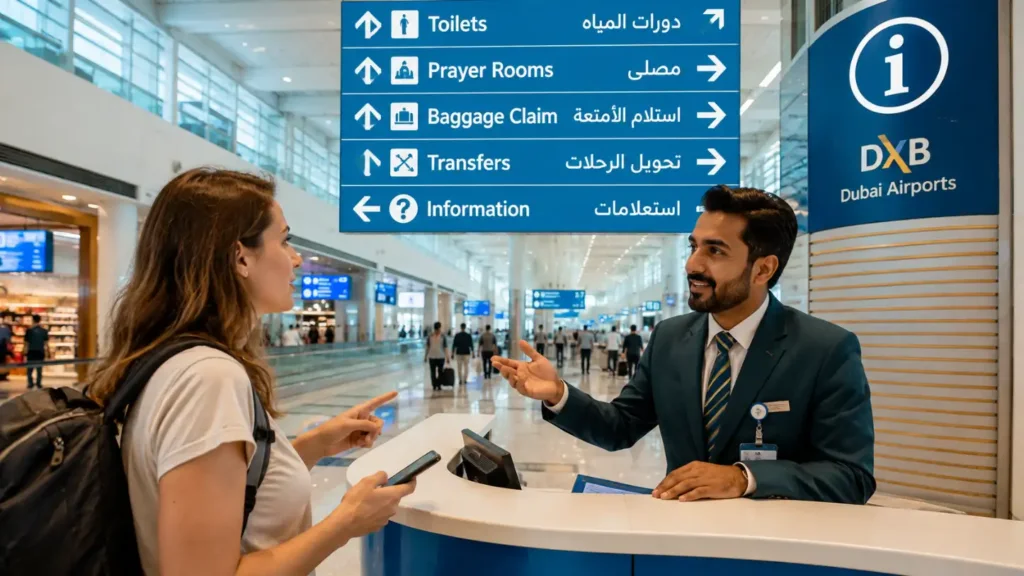
Dubai International Airport can feel huge when you have just landed, especially if you are tired, carrying bags, or trying to find a transfer, taxi, or hotel pickup.
The good news is that English is widely used at DXB, so you do not need Arabic to get through the airport. Still, a few simple Gulf Arabic phrases can make asking for help easier and more personal.
10 Useful Arabic Phrases at Dubai Airport
| Arabic | English | Say it |
|---|---|---|
| لو سمحت | Excuse me / Please | Law samaht |
| وين الجوازات؟ | Where is passport control? | Wain el-jawazat? |
| وين استلام الشنط؟ | Where is baggage claim? | Wain istilam esh-shanat? |
| شنطتي ما وصلت | My bag did not arrive | Shantati ma wasalat |
| وين الترانزيت؟ | Where is transit? | Wain et-transit? |
| وين البوابة؟ | Where is the gate? | Wain el-bawwaba? |
| ممكن تساعدني؟ | Can you help me? | Momken tsaedni? |
| وين التاكسي؟ | Where are the taxis? | Wain et-taksi? |
| أبغي أروح الفندق | I want to go to the hotel | Abghi arooh el-fundug |
| وين الحمام؟ | Where is the restroom? | Wain el-hammam? |
Start With “Excuse Me”
One of the most useful phrases at DXB is لو سمحت, meaning “Excuse me” or “Please.” Say it: Law samaht.
Use it before asking airport staff, a driver, or another traveler for help.
You can also simply say ممكن تساعدني؟, meaning “Can you help me?” Say it: Momken tsaedni?
That phrase works almost anywhere in the airport.
Finding Passport Control and Your Bags
After arriving, you may need to follow signs toward immigration or passport control.
If you are unsure, ask وين الجوازات؟, meaning “Where is passport control?” Say it: Wain el-jawazat?
Once you are through, you will probably be looking for your luggage.
Ask وين استلام الشنط؟, meaning “Where is baggage claim?” Say it: Wain istilam esh-shanat?
If your suitcase does not appear, tell a staff member شنطتي ما وصلت, meaning “My bag did not arrive.” Say it: Shantati ma wasalat.
Keep your baggage receipt or airline details handy so staff can identify the bag more easily.
Making a Connection
If Dubai is not your final destination, follow the airport signs for your connecting flight.
If you get turned around, ask وين الترانزيت؟, meaning “Where is transit?” Say it: Wain et-transit?
Closer to departure time, another useful question is وين البوابة؟, meaning “Where is the gate?” Say it: Wain el-bawwaba?
Show your boarding pass while asking. Even if your pronunciation is not perfect, the combination of the phrase and the flight information makes your meaning clear.
Finding a Taxi
After collecting your bags, you may be ready to get out of the airport and reach your hotel.
Ask وين التاكسي؟, meaning “Where are the taxis?” Say it: Wain et-taksi?
Once you are with the driver, you can say أبغي أروح الفندق, meaning “I want to go to the hotel.” Say it: Abghi arooh el-fundug.
It is still a good idea to show the driver the exact hotel name and location on your phone, especially if there are several hotels with similar names.
The Phrase Everyone Eventually Needs
Airports involve waiting, coffee, long walks, and sometimes very long flights.
So remember وين الحمام؟, meaning “Where is the restroom?” Say it: Wain el-hammam?
It may not be the most glamorous Arabic phrase you learn in Dubai, but it is certainly one of the most practical.
Do Not Worry About Perfect Arabic
DXB is an international airport, and you will hear many languages around you. Your Arabic is simply an extra tool.
Use لو سمحت, meaning “Excuse me.” Say it: Law samaht. Then ask ممكن تساعدني؟, meaning “Can you help me?” Say it: Momken tsaedni?
Those two phrases alone can carry you through a surprising number of airport situations.
Keep your boarding pass, hotel address, and flight details easy to reach, ask when you are unsure, and enjoy that first small moment of speaking Arabic before you even leave the airport.
Travel information can change. Recheck important prices, schedules, entry rules, health requirements and local regulations with the relevant official source before relying on them.