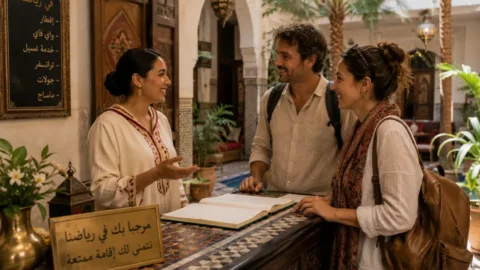
Navigating the Arab World: Western Arabic (123) vs. Eastern Arabic (١٢٣) Numerals
You check your hotel room number and see ٤١٢. Your taxi passes an exit marked ٢٣. A restaurant receipt shows ١٥٠. Nothing is wrong with the numbers. You are simply...




Navigating the Arab World is the focus of this EasyArabicNow guide, with practical travel context and useful planning tips for your trip.
You check your hotel room number and see ٤١٢. Your taxi passes an exit marked ٢٣. A restaurant receipt shows ١٥٠.
Nothing is wrong with the numbers. You are simply seeing a different set of digits.
Across the Arab world, travelers may encounter both Western Arabic numerals, the familiar 0, 1, 2, 3, and Eastern Arabic numerals, written ٠, ١, ٢, ٣.
The good news is that you do not need to become an expert. Learn to recognize the ten digits, and everyday travel becomes much easier.
Quick Answer
These two number systems represent exactly the same values:
123 = ١٢٣
50 = ٥٠
2026 = ٢٠٢٦
Which version you see depends heavily on the country and the setting. Local signs, prices and Arabic-language documents may use Eastern digits, while apps, international hotels, airport systems and digital services may use the familiar 123 style.
The 10 Digits to Recognize
| Arabic | English | Say it |
|---|---|---|
| ٠ | 0, zero | sifr |
| ١ | 1, one | wahid |
| ٢ | 2, two | itnayn |
| ٣ | 3, three | talata |
| ٤ | 4, four | arbaa |
| ٥ | 5, five | khamsa |
| ٦ | 6, six | sitta |
| ٧ | 7, seven | sabaa |
| ٨ | 8, eight | tamanya |
| ٩ | 9, nine | tisaa |
Spoken number words vary by dialect. For travelers, recognizing the written shapes is often more useful than memorizing one pronunciation for the entire Arab world.
Where Eastern Arabic Numerals Are Common
Eastern Arabic digits, ٠١٢٣٤٥٦٧٨٩, are especially important to recognize when traveling through much of the eastern Arab world.
You are likely to encounter them in Egypt and Sudan, as well as across the Levant, including Syria, Lebanon, Jordan and Palestine. They are also widely associated with Arabic-language number formatting in Iraq. Unicode’s current CLDR locale data uses Arabic-Indic digits as the default numbering system for Arabic locales in these countries.
They are also important in the Arabian Gulf. Arabic locale data for Saudi Arabia, Kuwait, Qatar, Bahrain and Oman defaults to Arabic-Indic digits. In real travel situations, however, familiar Western digits are also easy to encounter, particularly in digital services, international businesses and tourist-facing environments.
The United Arab Emirates is a particularly good example of why you should recognize both systems. Western digits are highly prominent, especially in modern and international settings, so a traveler in Dubai or Abu Dhabi should not expect every Arabic sign or transaction to use ١٢٣-style numerals. Current CLDR data also distinguishes the UAE from several neighboring Gulf Arabic locales by using Latin digits as the default.
The practical lesson is simple: in the eastern Arab world and Gulf, learn both 123 and ١٢٣.
What About Morocco and North Africa?
Travel west across North Africa and familiar Western digits become much more prominent.
In Morocco, Algeria, Tunisia and Libya, travelers will commonly see the same 0, 1, 2, 3 digit shapes they already use in English. Current Arabic locale data likewise defaults to Latin digits for these countries.
That makes numbers one of the easier parts of traveling in cities such as Marrakech, Casablanca, Algiers, Tunis or Tripoli.
It is better not to describe the entire Maghreb as using Western digits exclusively, however. Mauritania is an important exception to that simple rule, and Arabic-Indic digits remain relevant there. Unicode’s current locale data, for example, lists Arabic-Indic digits as the default for Arabic in Mauritania.
So think in terms of regional tendencies, not rigid borders.
Iran, Pakistan and Afghanistan Use Related Digits
Travelers may also encounter a related number system outside the Arab world.
Languages written with scripts derived from Arabic, including Persian and Urdu, use what Unicode calls Extended Arabic-Indic digits. They belong to the same numerical tradition, but some digit shapes differ from those commonly used in Arabic.
For example, Persian-style numbers can appear as:
۱۲۳۴۵۶۷۸۹۰
Compare that with the Arabic-Indic forms:
١٢٣٤٥٦٧٨٩٠
The difference becomes especially noticeable with some digits, including forms of 4, 5 and 6. Unicode documents variations among Persian, Urdu and other languages using these extended digits.
You may see these related forms in Iran, and in languages used in Pakistan and Afghanistan. Do not worry about memorizing another complete chart unless your trip includes those countries. Just know that the numerals can look slightly different from the ١٢٣ forms you learned for Arabic-speaking destinations.
The Digits That Usually Cause Trouble
Several Eastern Arabic numerals are easy to learn quickly.
١ is 1.
٢ is 2.
٣ is 3.
The ones worth studying for an extra minute are:
٥ = 5, because it can look like a small circle.
٦ = 6, because English-speaking travelers sometimes mistake it for another familiar digit.
٧ = 7 and ٨ = 8 are useful to memorize together.
٩ = 9 usually becomes easy to recognize after you have seen it a few times.
Keep the chart on your phone. After checking a few prices, room numbers and signs, the shapes start becoming familiar surprisingly quickly.
How Multi-Digit Numbers Work
This part is easier than many travelers expect.
Although Arabic text normally runs from right to left, the digits inside a number keep their numerical sequence.
So:
١٢٣ means 123, not 321.
٤٥ means 45.
٢٠٢٦ means 2026.
Do not reverse the digits simply because the surrounding Arabic text is written from right to left.
Where These Numbers Matter Most
You do not need instant recognition of every large number. Focus on situations where understanding the digits makes travel easier:
- Hotel room numbers
- Gates and platform numbers
- Bus and train numbers
- Street addresses
- Restaurant bills
- Market prices
- Queue numbers
- Elevator floors
- Dates and times
- Phone numbers
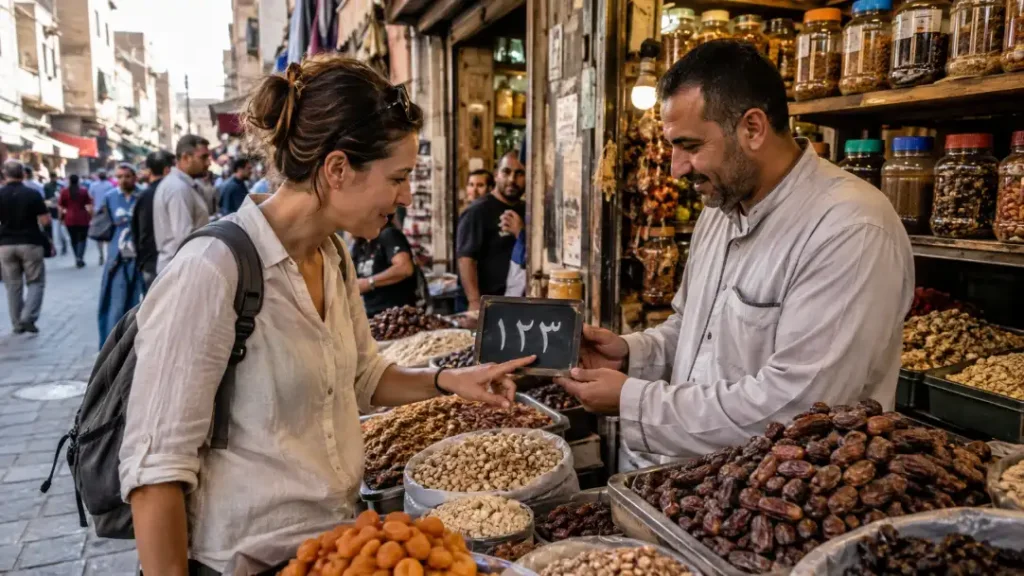
At a market, written numbers can be especially helpful. If a seller shows you ٨٠, you can recognize 80 even if you did not understand the spoken number.
Use Your Phone When You Need It
Your phone calculator is one of the simplest communication tools you have.
If you cannot understand a spoken price, open the calculator and let the other person type the amount. Travelers and locals often use screens, calculators and written numbers when language gets in the way.
You can do the same for taxi fares, quantities, meeting times or room numbers.
A smile and a calculator can solve a surprising number of travel conversations.
Before You Go
You do not need to write Eastern Arabic numerals perfectly. Recognition is the useful travel skill.
Remember that ١٢٣ means 123, learn the shapes of ٠ through ٩, and pay particular attention when traveling in Egypt, the Levant, Iraq and much of the Gulf.
In Morocco and much of North Africa, familiar Western digits will generally make life easier. And if your journey continues to Iran, Pakistan or Afghanistan, expect related numerals with a few different shapes.
Once you start noticing them on signs, receipts and prices, what looked mysterious becomes just another small part of navigating the region.
Travel information can change. Recheck important prices, schedules, entry rules, health requirements and local regulations with the relevant official source before relying on them.